Blog

Blog

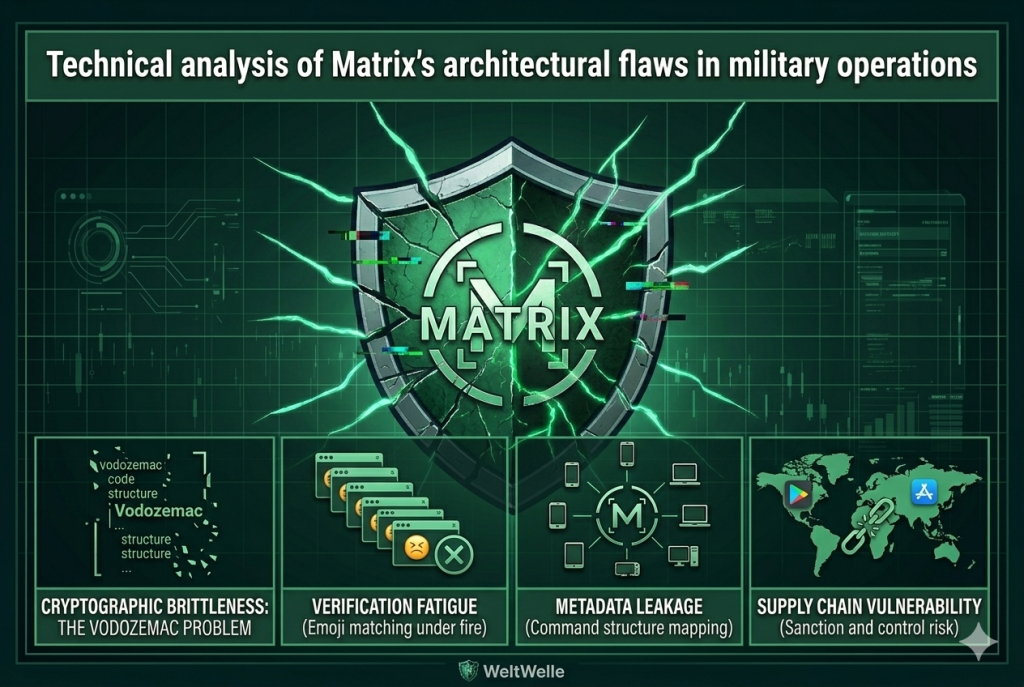
Why Matrix Fails in Military Operations: A Technical Deep Dive into Cryptographic Brittleness and Design Flaws

Why Matrix Fails in Military Operations: A Technical Deep Dive into Cryptographic Brittleness and Design Flaws Published: March 5, 2026 | Reading time: 12-14 minutes The adoption of Matrix and Element across military and government networks has been celebrated as a major victory for end-to-end encryption and digital sovereignty. Yet a closer examination of how these systems perform under active conflict conditions reveals a fundamental mismatch between civilian design principles and the operational reality of modern warfare. This isn’t a critique of Matrix as a civil communications platform. Rather, it’s an examination of what happens when a system designed for privacy-conscious civilians encounters threats for which it was never architected. Recent cryptographic analysis, particularly the work detailed in soatok’s examination of vulnerabilities in vodozemac, has exposed fault lines that should concern anyone deploying Matrix in high-stakes security operations. The issues extend beyond cryptography into operational security, administrative privilege models, and the role of human error in systems designed with too many moving parts. Cryptographic Brittleness: The Vodozemac Problem The migration from libolm to vodozemac, Rust’s cryptographic library for Matrix, was presented as a security improvement. In reality, it introduced a new category of risk. The library underwent significant rewrites and now maintains a growing set of documented issues that allow attackers to mount key extraction attacks and session integrity violations in ways that were not previously possible. The core issue isn’t that vodozemac is poorly written. Rather, it’s that Matrix’s approach to cryptographic updates creates what we might call a “constant flux” problem. With hundreds of contributors across dozens of organizations and jurisdictions modifying the codebase continuously, there is no stable cryptographic baseline. A military unit cannot simply deploy Matrix, validate its security properties, and maintain that validation indefinitely. Instead, every patch, every update from the open source community brings the possibility of new attack vectors. This becomes more than a technical concern when you understand the operational context. A military unit cannot quickly rotate to a different cryptographic library if an issue emerges. They cannot fork the project and maintain their own secure version without the resources of a dedicated cryptographic team. They are locked into accepting whatever the open source community produces, including contributions from actors in adversarial nations or those influenced by state sponsors. Consider this scenario: A single commit from a contributor claiming to fix a performance issue is merged into vodozemac. The change introduces a subtle bias in random number generation. This bias goes undetected in testing because it only manifests under specific operational conditions that civilian testers never encounter. Meanwhile, an intelligence agency with advanced cryptanalysis capabilities discovers the flaw and quietly exploits it. By the time the military discovers the problem, years of communications have been compromised.   Verification Fatigue as an Attack Surface In Matrix, the cross-signing and emoji verification process is presented as essential to security. In military practice, it becomes a liability. When a new device joins a secure channel with 500 participants, the system prompts for verification. This means comparing a sequence of emoji across devices to confirm the connection is legitimate. In theory, this is good security practice. In the reality of field operations, it’s a humanitarian disaster waiting to happen. An officer directing a tactical operation under fire is not going to carefully verify all ten emoji matches for a new participant. They will either skip the verification entirely or perform a cursory check that would satisfy an attentive observer but represents no actual security validation. This creates what cryptographers call “verification fatigue.” The system offers many security choices, most of which the operator abandons under stress. An adversary who understands this behavior can exploit it systematically. By positioning a Man-in-the-Middle attack at a network chokepoint, an adversary can present spoofed verification prompts that appear legitimate enough for a stressed operator to accept. The attack unfolds quietly. The compromised device now relays all future messages to the attacker. But there are no alerts, no suspicious logs, no indication that anything has gone wrong. The officer continues to believe they are communicating securely with their unit while every word is being intercepted. The fundamental problem is that Matrix made security decisions that assume civilian use cases where operators have time to make careful choices. Military operations do not provide this luxury. Metadata Leakage: The Intelligence Goldmine Most discussions about encrypted communications focus on message content. In military operations, metadata is often more valuable than the messages themselves. Matrix’s architecture makes metadata extraordinarily visible to anyone with administrative access to the server. An administrator of a Matrix server can observe in real time who is communicating with whom, how frequently these communications occur, what time of day the communication is heaviest, and what device types are being used. All of this is visible even if every single message is encrypted with perfect forward secrecy. Now consider what an intelligence operation can do with this information. If the adversary manages to compromise a Matrix server administrator through recruitment or exploitation, they gain access to a comprehensive map of your command structure without ever needing to decrypt a single message. The intelligence value of metadata was established long before encrypted communications became widespread. The NSA’s metadata collection programs targeted communications metadata because it reveals operational patterns that are often more useful than content. A signal analyst observing that Battalion A communicates with Battalion B every evening at 22:00 can infer operational planning, can estimate shift rotations, can even predict when offensive operations are likely to commence. Furthermore, an administrator can observe which geographic locations devices are connecting from, what times people log in and out, how many hours they spend in a channel. An intelligence analyst with access to this metadata can estimate stress levels, predict staff changes, and identify key personnel simply by observing who maintains presence in which channels. Matrix’s federation model compounds this problem. The system creates implicit trust relationships between servers. If one federated server is compromised, it can potentially gather metadata about activity on other
Global cyber warfare concept with world map, hacker silhouette, military operator, and digital security locks illustrating hybrid cyber threats and secure communications — image for article by Sergiy Cherskoi about WeWe3
Blog

Why Secure Messengers Are Failing in Modern Hybrid Warfare

Why Secure Messengers Are Failing in Modern Hybrid Warfare   Sergiy Cherskoi (Черской Сергей / Сергій Черський) Cybersecurity Specialist • CEO WeWe3 WeltWelle — Digital Sovereignty & Secure Communications Research Contents Introduction Encryption vs Control Credential-centric attacks Social engineering as a strategic weapon Insider threat AI-driven cyber operations Why public secure messengers fail From privacy tools to strategic infrastructure Sovereign cryptographic communication Strategic implications Conclusion Introduction Modern cyber warfare has shifted fundamentally. The primary vulnerability is no longer cryptography, network protocols, or device hardening. Instead, the weakest link is the human-access layer: credentials, trust relationships, insider access, and manipulated identity. Across defense and governmental ecosystems, incidents increasingly show the same pattern: systems fail not because encryption is broken, but because access is stolen, identities are impersonated, and trusted roles are abused. This is hybrid warfare logic: the goal is not just data theft, but operational disruption, strategic deception, and decision manipulation. In this environment, conventional secure messengers, even with strong end-to-end encryption, are often insufficient. 1) The illusion of security: encryption vs control For years, the industry pushed a simple equation: end-to-end encryption equals security. Encryption protects content during transmission. But it does not protect against account takeover, credential phishing, insider misuse, identity spoofing, or social engineering within command structures. Once an attacker gains legitimate access, encryption becomes irrelevant. The attacker is no longer breaking the system. They are becoming a trusted user inside it. This changes defense from a cryptographic problem into an architectural sovereignty problem. 2) The rise of credential-centric attacks Modern campaigns increasingly target authentication and access rather than cryptography. Typical techniques include: MFA fatigue and real-time phishing proxy attacks Voice phishing (vishing) that impersonates IT administrators Deepfake audio/video impersonation of leadership SIM swap operations to intercept authentication flows Spear-phishing against high-value insiders These methods allow adversaries to operate inside trusted environments while bypassing traditional intrusion signals. The battlefield has moved from firewalls to human perception and organizational process. 3) Social engineering as a strategic weapon Social engineering is no longer a side risk. It is a primary strategic weapon. It exploits hierarchy, urgency, and routine communication habits, especially under cognitive overload. In defense contexts, a compromised messenger account can be used to issue false instructions that look legitimate. The damage is not limited to leaks. It includes disruption of command chains, misallocation of resources, exposure of tactical positions, loss of initiative, and direct risks to human lives. 4) Insider threat: the invisible layer of hybrid warfare One of the most underestimated risks is the insider threat. Insiders are not always malicious. They can be coerced, socially engineered, phished, operating on infected devices, or acting on manipulated instructions. Traditional messengers assume any authenticated user is legitimate. That assumption is no longer valid. Nation-state adversaries increasingly target officers, government advisors, R&D engineers, political decision-makers, and defense contractors. Often the objective is not immediate theft, but mapping relationships and influencing decision flows over time. 5) AI-driven cyber operations: the next escalation Artificial intelligence accelerates offensive cyber capabilities. Adversaries now use AI to generate hyper-personalized phishing, analyze communication patterns to mimic writing style, create deepfake voice messages, and automate identity impersonation at scale. The result is a new operational reality: the attacker does not need to hack encryption. They only need to convincingly impersonate a legitimate participant within the system. 6) The structural failure of public and open secure messengers Most popular secure messengers were designed for civilian privacy, not for state-level hybrid warfare environments. Even with strong encryption, they often remain vulnerable to account hijacking, group infiltration, metadata analysis, and behavioral pattern mapping. This means adversaries can observe operational dynamics without decrypting a single message. In high-stakes communications, that visibility is strategically valuable. 7) From privacy tools to strategic infrastructure Secure communication is no longer just a privacy feature. It is strategic national infrastructure. Modern defense communications must be designed not only to encrypt messages, but to reduce trust dependencies, anticipate insider risk, harden identity against impersonation, and eliminate unauthorized architectural interference. The focus must move from message protection to communication sovereignty. 8) The concept of sovereign cryptographic communication To resist hybrid warfare threats, communication systems require an architecture where: No external entity can intervene in transmitted information Access to message content is technically impossible for any service operator Identity management is structurally protected against impersonation Insider risk scenarios are anticipated and mitigated at the protocol level Deployment remains under jurisdictional control of the owner Such systems are not “just messengers.” They operate as cryptographic command infrastructures aligned with modern defense requirements. 9) Strategic implications for defense and government communications Ignoring credential-based and insider-driven threats leads to predictable outcomes: exposure of sensitive communications, strategic misdirection, manipulation of decision-making processes, erosion of trust inside command hierarchies, and increased vulnerability during active operations. Hybrid warfare attacks psychological and structural weaknesses more than technical ones. Therefore, resilience must be measured not only by encryption strength, but by resistance to deception, impersonation, and insider compromise. Conclusion The era when encryption alone guaranteed secure communication is over. The decisive battlefield is trust architecture, not cryptographic algorithms. Adversaries increasingly win not by breaking encryption, but by entering systems as trusted participants. This reality exposes the limitations of conventional secure messengers and requires a shift toward sovereign, architecture-controlled communication infrastructure. In military operations, governmental decision-making, and strategic R&D, secure communication must evolve from a privacy tool into a sovereign digital defense capability. WeltWelle Insight: True security is defined not by encryption alone, but by independence of architecture and the technical impossibility of external intervention in the communication process.

Blog

Roskomnadzor Registry, the Yarovaya Law, and the Geopolitics of Digital Control

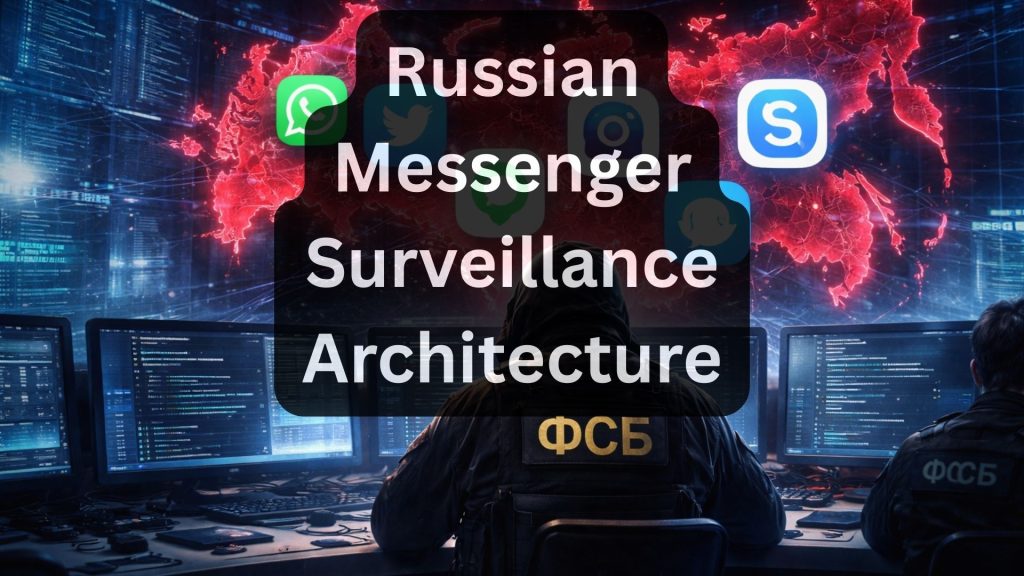
Russian Messenger Surveillance Architecture Roskomnadzor Registry, the Yarovaya Law, and the Geopolitics of Digital Control Author: Sergiy Cherskoy (Сергей Черской / Сергій Черськой) Cyber Security Specialist CEO WeWe3 https://weltwelle.com/ Introduction Since 2016, the Russian Federation has constructed a comprehensive legal and technical framework that fundamentally reshapes the nature of digital communication within its jurisdiction. At the center of this system are: The Yarovaya legislative package The Registry of Information Dissemination Organizers (ORI) maintained by Roskomnadzor Mandatory data retention and decryption obligations imposed on online platforms This framework does not merely regulate digital services. It integrates communication platforms into a state-controlled surveillance architecture. Understanding how this system functions is critical not only for regional security analysis, but for evaluating the geopolitical dimensions of digital sovereignty worldwide. 1. Legal Foundation: The Yarovaya Package In 2016, Russia adopted the so-called “Yarovaya package” (Federal Laws No. 374-FZ and No. 375-FZ), which significantly expanded state authority over digital communications. The legislation amended the Federal Law “On Information…” (Article 10.1), introducing the concept of Information Dissemination Organizers (ORI). In 2018, Government Resolution No. 445 further specified: Data storage obligations Retention timeframes Technical compliance requirements This regulatory structure formalized state access mechanisms into the legal environment of online services. 2. The ORI Registry: Institutionalizing Surveillance Roskomnadzor maintains a centralized registry of services classified as Information Dissemination Organizers. The registry includes any platform that enables electronic communication, including: Messengers Social networks Forums Dating platforms Other communication-enabled digital services Inclusion in the ORI registry triggers legally binding obligations. Obligations Imposed on Listed Services Platforms included in the registry must: Store message content (text, voice, video, files, images) of Russian users for at least six months (in some regulatory interpretations up to one year). Store metadata (connection records, timestamps, IP addresses, sender and recipient information) for up to three years. Provide stored data to Russian law enforcement agencies, including the FSB, upon request. If encryption is used, provide decryption keys or technical means sufficient to decode communications. Ensure the possibility of remote automated access by security authorities. Failure to comply can result in fines, regulatory pressure, or service blocking. The well-known conflict between Russian authorities and Telegram over encryption keys is an example of this enforcement model. 3. Expansion to International Messengers By the end of 2024, the ORI registry contained more than 450 services. In December 2024, numerous international messengers were added to the registry, including: WhatsApp (Meta) Skype Wire Element Threema Telegram Session DUST Keybase Trillian Status Crypviser Pinngle Safe Messenger Inclusion means that, under Russian law, these platforms are recognized as Information Dissemination Organizers and must comply with the full set of Yarovaya obligations. The case of the Swiss messenger Threema, added to the registry in 2017, illustrates how even platforms marketed as privacy-oriented may become legally exposed within certain jurisdictions. 4. Practical Consequences: “Transparency” as a Legal Requirement The Russian regulatory model establishes legally mandatory transparency for any service that: Is included in the ORI registry Continues to operate legally within the Russian market This has several implications: The confidentiality of correspondence becomes conditional. End-to-end encryption is subject to legal override. Architectural modifications may be required to ensure access capability. Even when companies publicly state that they do not cooperate with authorities, the legal obligations remain binding. Inclusion in the registry signifies ongoing regulatory pressure and compliance exposure. 5. Geopolitical Implications: Communication Platforms as Instruments of State Power The ORI registry model demonstrates how digital infrastructure can be systematically integrated into national security architecture. Communication platforms are no longer neutral technological intermediaries. They are increasingly embedded within sovereign regulatory systems that can compel access. Under the Yarovaya framework, legal authority extends beyond passive monitoring. It institutionalizes access capability. This reflects a broader geopolitical shift: digital regulation has become an instrument of strategic state power. 6. From Encryption to Jurisdiction: The Real Axis of Control Cybersecurity discourse often emphasizes encryption standards — AES-256, RSA-4096, end-to-end encryption, zero-knowledge architecture. However, encryption alone does not determine security. Jurisdiction does. If a platform operates within a legal system that mandates access to communications, encryption becomes conditional rather than absolute. Legal compulsion can supersede architectural claims. This transforms secure communication from a technical feature into a sovereignty question. 7. Structural Risk in a Fragmented Digital Order Global platforms frequently operate across jurisdictions with divergent legal systems. When a messenger remains legally active in a surveillance-oriented regulatory environment, it may face: Regulatory coercion Compelled technical adaptation Data retention mandates Gradual integration into access frameworks This creates structural risk that may extend beyond national borders. Governments, corporations, defense institutions, and critical infrastructure operators may unknowingly rely on communication systems legally exposed to adversarial oversight. 8. Regulatory Integration as a Surveillance Strategy The ORI registry illustrates a broader global trend: States increasingly formalize surveillance through legal integration rather than covert intrusion. Rather than hacking platforms, they regulate them into compliance. This approach offers: Legal legitimacy Long-term enforceability Scalable access Institutional normalization Once embedded, such mechanisms operate predictably and systematically. 9. Strategic Conclusion The Yarovaya framework and ORI registry provide a concrete example of how legal structures can reshape the security properties of digital platforms. For global actors, the central question is no longer: “Is this messenger encrypted?” The decisive question is: “Under which sovereign authority does this platform ultimately operate?” In a multipolar digital environment, encryption without jurisdictional sovereignty does not equal strategic security. It represents conditional privacy within a legally subordinated framework.

WeWe secure messenger illustrating encryption key ownership and digital sovereignty
Blog

When Encryption Is Not Yours: The BitLocker Case and Why This Is Impossible in WeWe Military and Enterprise

When Encryption Is Not Yours: The BitLocker Case and Why This Is Impossible in WeWe Military and Enterprise When Encryption Is Not Yours: The BitLocker Case and Why This Is Impossible in WeWe Military and Enterprise The news that Microsoft publicly transferred BitLocker recovery keys under an FBI court order became a landmark case for the entire cybersecurity industry. It clearly demonstrated: the presence of encryption does not automatically mean real control over your own data. Why This Was Possible in BitLocker In the case of BitLocker, recovery keys are automatically stored in cloud infrastructure if the user is logged in with a Microsoft account. This means that the company technically has access to the keys and is legally obligated to provide them upon lawful request. If such technical access exists, it can be abused by corrupt authorities under fabricated criminal cases against businesses or politicians (a practice widely observed in Ukraine), as well as by hired hackers (for example, Russian actors operating in technology and military domains). It is important to understand: this is not a vulnerability or a mistake — it is a deliberate architectural decision. The Key Question of Any Encryption System Who owns the keys, and is there a technical possibility to transfer them? If the keys: are stored by the vendor, can be recovered, exist in an exportable form, the scenario of transferring them via a court order or cybercrime is inevitable by definition. The Fundamental Difference of WeWe Military and WeWe Enterprise In WeWe Military and WeWe Enterprise models, a completely different approach is used: the customer purchases the entire WeWe system and becomes its sole owner; servers, infrastructure, and data fully belong to the client; the developer or administrator has no architectural access to the system. In this model, there is simply no entity capable of transferring encryption keys to a third party. How Cryptographic Keys Are Stored in WeWe The WeWe architecture eliminates the storage of keys in any transferable form: private RSA keys are never stored in plaintext; each key is encrypted using AES-256; the AES key is derived from the user’s PIN via PBKDF2; a multi-layer scheme with different salts is used. Even physical access to servers does not allow retrieval of usable keys without the user’s PIN. Automatic and Irreversible Data Destruction Multiple incorrect PIN attempts result in complete and irreversible destruction of keys and data. data recovery is technically impossible; access cannot be recreated; even the infrastructure owner cannot restore the data. Why “There Is Nothing to Transfer” Is a Technical Fact Unlike cloud ecosystems, WeWe has: no centralized key storage; no master access; no recovery mechanism. Therefore, a BitLocker-like key transfer scenario is architecturally impossible in WeWe Military and Enterprise. Conclusion The BitLocker case revealed the limitation of cloud-based key custody. full client ownership; multi-layer cryptographic protection; cryptographic impossibility of third-party access. WeWe Military and WeWe Enterprise are enterprise-grade secure communication systems designed for business, government institutions, and specialized units, where full control over data belongs exclusively to the infrastructure owner.

WeWe 3 secure messenger – key ownership and digital sovereignty
Blog

Key Ownership and Digital Sovereignty: Why True Security Starts with WeWe

Key Ownership and Digital Sovereignty: Why True Security Starts with WeWe Encryption strength does not define security. Key ownership, jurisdiction, and architecture do. Why Encryption Alone No Longer Protects Your Data For years, digital security was explained through algorithms: AES-256, RSA-4096, certificates, compliance. But real incidents — involving cloud providers, court orders, and lawful access — have shown a deeper truth: Security does not fail at the level of algorithms. It fails at the level of key ownership. If encryption keys are accessible to someone else — even theoretically — then control over data is shared, not absolute. This is the precise problem WeWe was designed to solve. The Real Question: Who Controls the Keys? Forget marketing terms like “end-to-end” or “zero trust”. There is only one question that matters: Who can technically obtain or disclose the cryptographic keys? If keys: are stored in cloud infrastructure, can be recovered through a provider, exist in exportable or recoverable form, then your data sovereignty is conditional — regardless of encryption strength. WeWe starts from the opposite assumption: no third party must be able to access keys — including the vendor. Encryption vs Sovereignty: A Critical Distinction Most secure messengers answer the question: “How is the data encrypted?” WeWe answers a different, more important one: “Who is technically able to control access?” This distinction defines whether your system is merely encrypted — or truly sovereign. Digital Sovereignty Is an Architectural Choice Digital sovereignty is not a political slogan. It is the direct result of system architecture. A communication system can only be considered sovereign if: encryption keys are generated and controlled by the owner, keys are never stored in external cloud services, there are no centralized recovery or master-access mechanisms, even the system developer has no technical access to message content. This is not an optional feature in WeWe — it is the foundation of the platform. Jurisdiction: The Hidden Attack Vector If a provider can access keys or metadata, jurisdiction becomes a security issue. Cloud companies operate under specific legal systems. Court orders, regulatory demands, and lawful access requests apply where technical access exists. Key insight: If there is no technical access to keys, there is no legal entity capable of disclosing them. WeWe eliminates this vector by design. Why “End-to-End Encryption” Is Often Not Enough Many messengers claim end-to-end encryption, yet still: store backups in the cloud, use provider-controlled recovery keys, retain metadata or re-issuable credentials. In such systems, encryption protects transmission — but not sovereignty. WeWe removes cloud dependency entirely from the key lifecycle. Convenience vs Control: The Trade-Off Most Platforms Make Mass-market platforms optimize for convenience: password recovery, account restoration, centralized administration. This convenience comes at a price: delegated control. WeWe is built for environments where data loss is preferable to data compromise. Where the Real Security Boundary Lies True security begins where: forced access through a provider is impossible, no third party can disclose keys, legal orders have no technical target. If no one can hand over the keys, access remains a cryptographic problem — not a legal one. This boundary is exactly where WeWe operates. Why WeWe Removes These Risks Entirely WeWe is built on a simple but radical principle: The owner of the system is the owner of the keys — always. In WeWe: there is no external cloud storing encryption keys, there is no vendor-controlled recovery access, there is no technical possibility for third-party disclosure, even WeWe itself cannot access message content. This makes WeWe suitable for on-premise, sovereign, and high-risk environments where compromise is not acceptable. This is an architectural property, not a policy or promise. Who WeWe Is Designed For Absolute key control is critical for: government and defense institutions, law enforcement and special units, critical infrastructure operators, enterprises handling sensitive or regulated data, organizations operating in hostile or high-risk jurisdictions. For these users, “trusting the provider” is not an option. Final Conclusion: Why WeWe Exists Encryption alone does not guarantee security. Control over keys does. WeWe exists for organizations that require: digital sovereignty by design, zero third-party access, full ownership of communication infrastructure. Where other messengers stop at encryption, WeWe starts with sovereignty.

Blog

Article about BitLocker: how recovery keys work and why their transfer is possible under a court order in a cloud-based model.

Article about BitLocker: how recovery keys work and why their transfer is possible under a court order in a cloud-based model. The news that Microsoft has, for the first time, publicly transferred BitLocker recovery keys to law enforcement agencies under a court order caused significant public reaction. For many, this looked like a violation of a fundamental data-protection principle: how is it possible to access encrypted information without breaking the encryption? In reality, this case is neither an exception nor a technical anomaly. It demonstrates the boundary of a specific security model — a model that for many years has been considered acceptable for mass-market and corporate systems. To understand what exactly happened, it is important to consistently examine: how BitLocker works, what recovery keys are and why they exist, where exactly these keys are stored, on what legal grounds they can be transferred, and why this does not constitute a break of encryption. What BitLocker Is and What It Was Designed For BitLocker is a full-disk encryption system built into the Windows operating system. It was created to solve practical and very common tasks: protecting data in case of device loss or theft, preventing access to information when a storage device is physically removed, and providing a baseline level of security in corporate environments. From a technical standpoint, BitLocker is implemented correctly: it uses standard cryptographic algorithms, supports integration with TPM modules, and applies well-established approaches to protecting data “at rest”. The key point lies elsewhere: BitLocker has never been positioned as a system with full cryptographic autonomy for the user. The Threat Model BitLocker Is Designed For BitLocker is effective against accidental laptop loss, device theft, unauthorized access by third parties, and attempts to read a disk outside the operating system. At the same time, it is not designed to withstand scenarios such as legal or state coercion, court orders, or situations where the manufacturer or service provider has access to the keys. This is not a flaw or a mistake, but a deliberate architectural trade-off in favor of usability and recoverability. BitLocker Recovery Keys: Why They Exist BitLocker includes a recovery key mechanism — a key that allows access to an encrypted disk to be restored. Its purpose is to prevent data loss in situations that occur regularly in practice: TPM module failure or replacement, hardware configuration changes, system configuration errors, user password loss, and corporate administration scenarios. For mass-market users, this is a critically important feature. Without a recovery mechanism, BitLocker would become a constant source of irreversible data loss. Where BitLocker Keys Are Stored This is the central point of the entire story. In modern versions of Windows, if a user signs in with a Microsoft account: BitLocker recovery keys are automatically stored in Microsoft’s cloud infrastructure; the user can view them through their account; storage happens by default and often without an explicit, conscious decision by the user. In practical terms, this means: Microsoft technically has access to the recovery keys. What Exactly Is Provided to Law Enforcement In such cases, it is not the user’s data itself that is transferred, but the recovery keys that allow the entire disk to be decrypted and full access to all information stored on the device. The company does not break cryptography, bypass protection, or “decrypt” data internally. It provides what is already stored within its infrastructure. Legal Grounds for Key Transfer Microsoft is a company operating under U.S. jurisdiction and is therefore obligated to comply with U.S. law. The transfer of keys is possible based on court orders and lawful requests from law enforcement agencies within legally established procedures. If a company technically has access to keys or data, it is legally required to provide them upon a lawful court order. This is not a matter of goodwill, but a legal obligation. The transfer of BitLocker recovery keys to law enforcement under a court order represents legal, not technical, access. Why This Does Not Mean BitLocker Is Compromised The transfer of BitLocker keys is often mistakenly interpreted as a “hack” or a “failure” of the security system. This is incorrect. It does not mean cryptographic algorithms were broken. It does not indicate vulnerabilities. It does not mean access is available to anyone. BitLocker functions exactly as designed. The boundary lies not in cryptography, but in key-management architecture. The Architectural Boundary of Cloud Systems BitLocker is a typical example of a system where usability and recoverability take priority, keys can be stored centrally, and the infrastructure owner is legally and technically defined. technically possible; legally justified; architecturally anticipated. This is not a failure, but the boundary of the cloud security model. The Existence of Alternative Architectures At the same time, centralized key storage is not the only possible approach. keys are not stored in cloud services; there is no centralized access provider; the transfer of keys to third parties is technically impossible. Read more (blog analysis): When Encryption Is Not Yours: Architectural Limits of Modern Security Systems Why This Case Matters Right Now Recent years have shown that threats increasingly go beyond classic technical attacks. For many organizations, the key question has become: does anyone exist who can gain access to the keys — even theoretically? This question lies at the heart of discussions about digital sovereignty and data control. Read more (blog analysis): Key Ownership and Digital Sovereignty: Where the Real Security Boundary Lies Final Conclusion The transfer of BitLocker keys is a consequence of architectural decisions and occurs on lawful grounds. It is not a hack or a compromise of encryption. This case highlights the difference between protection against accidental threats and protection against legal or state coercion. Understanding this distinction is critically important for anyone working with sensitive information — regardless of industry.

Blog

The WeWe3 Military project, which is being implemented in Ukraine with the participation of GATA.world, has been nominated for the DOU Awards 2026 in the DefTech category

WeWe3 Military, The project, whose implementation and expert support in Ukraine is facilitated by GATA.world, has been nominated for the DOU Awards 2026 in the category “The Most Promising Project in the DefTech Industry.” Below are the details and a comment from the CEO of GATA.world. The WeWe3 Military project, the implementation and expert support of which in Ukraine is facilitated by GATA.world, has been included in the list of nominees for the DOU Awards 2026 in the category “The Most Promising Project in the DefTech Industry”. Detailed presentation at the link: https://weltwelle.com/military-presentation/ Voting is open on the official award page: https://dou.ua/awards-2026/#voting The nomination of WeWe3 Military at the DOU Awards 2026 is a confirmation of the high appreciation from the Ukrainian IT and DefTech community.This category includes solutions that demonstrate practical impact, innovation, and scalability potential in the field of security and defense technologies. GATA.world participates in the implementation, expertise and coordination of the use of WeWe3 Military in Ukraine, adapting the system to practical operating conditions and current security requirements. This approach ensures that the solution meets real operational scenarios and increased requirements for information protection in a high-risk environment. Comment by CEO GATA.world “The nomination of WeWe3 Military for the DOU Awards 2026 is an important confirmation that the DefTech community sees value in solutions that are already working in Ukraine today. For our team, this is not only recognition, but also responsibility. I invite colleagues, partners, and representatives of the IT and security community to support WeWe3 Military in voting. This is an opportunity to show that Ukrainian DefTech solutions are able to meet the highest security standards,” — Serhiy Vasylyovych Cherskoy, CEO of GATA.world. Support Ukrainian DefTech — vote for the WeWe3 Military project at the DOU Awards 2026. https://dou.ua/awards-2026/#voting About DOU Awards 2026 DOU Awards 2026 is an annual award from the DOU community that recognizes the best Ukrainian IT and technology projects. The DefTech category focuses on solutions that enhance Ukraine’s defense capabilities, security, and technological resilience. More details:https://dou.ua/awards-2026/

Scroll to Top